

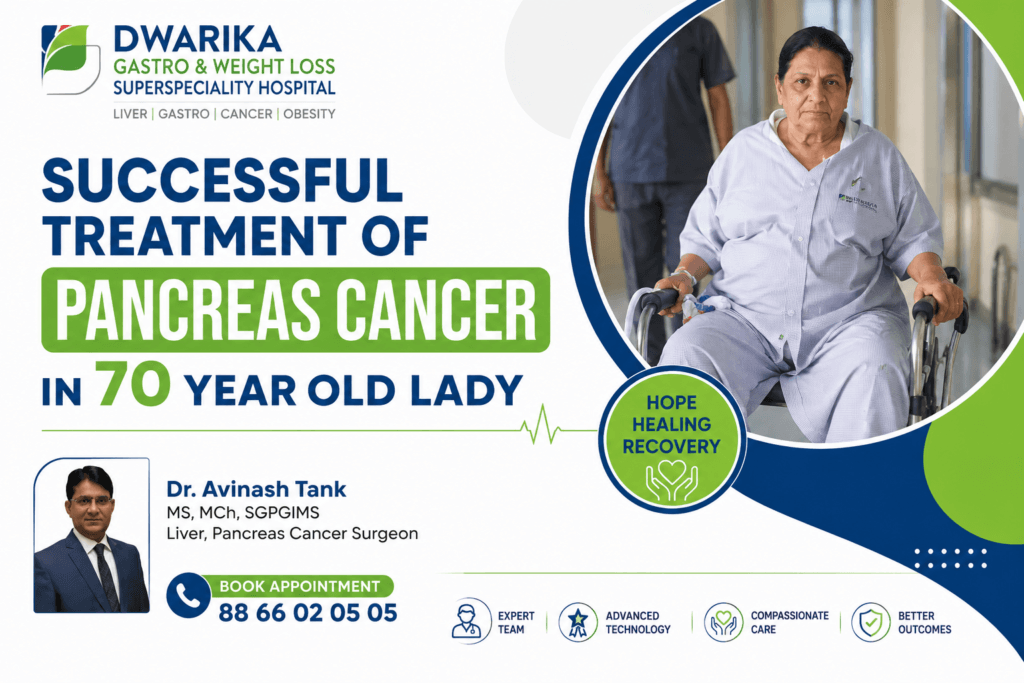
When Hope Meets Expertise: A 70-Year-Old Woman’s Journey Through Pancreatic Cancer
“I thought my age and health problems would make treatment impossible. But my journey taught me that every patient deserves a chance.”
A diagnosis of pancreatic cancer can feel overwhelming. For many families, it brings fear, uncertainty, and countless questions. Yet every patient’s story reminds us that while pancreatic cancer is one of the most challenging cancers to treat, timely diagnosis, personalised treatment, and expert surgical care can make a meaningful difference.
This is the story of a 70-year-old woman from Ahmedabad whose journey highlights not just medical expertise, but also the power of resilience, family support, and hope.
Please note: This article shares the experience of one patient. Every pancreatic cancer is different, and treatment outcomes vary depending on the stage of the disease, overall health, tumour characteristics, and individual response to treatment.
When Everyday Symptoms Shouldn’t Be Ignored
What began as persistent abdominal pain and loss of appetite gradually became impossible to dismiss. Like many people with pancreatic cancer, her symptoms were subtle at first—easy to mistake for common digestive problems.
Further investigations revealed a tumour in the head of the pancreas. The diagnosis was particularly challenging because she also had several existing medical conditions, including obesity, high blood pressure, reduced lung function due to previously healed tuberculosis, and limited physical mobility. Despite these complexities, detailed imaging showed that the disease remained localised, allowing the healthcare team to explore curative treatment options.
More Than Just a Diagnosis
Cancer treatment is never based on age alone.
Although she was 70 years old and had multiple health concerns, her medical team carefully assessed her overall fitness, imaging findings, blood investigations, and surgical risks before recommending treatment. This reflects an important principle in modern cancer care: treatment decisions are personalised for every individual rather than determined solely by age.
A Complex Operation, Planned with Precision
Surgery for pancreatic cancer is among the most technically demanding procedures in gastrointestinal surgery. In this patient’s case, the operation became even more challenging because of obesity, fatty liver changes, a soft pancreas, and anatomical variations in the bile ducts.
Despite these difficulties, the surgical team successfully completed the procedure with careful planning and meticulous technique. While the operation lasted many hours, every decision was focused on achieving the safest possible outcome.
Recovery Is a Journey, Not a Single Day
The operation was only the beginning.
After surgery, she required close monitoring in the intensive care unit as her oxygen levels and blood pressure fluctuated. With continuous support from doctors, nurses, physiotherapists, and her family, she gradually regained strength.
By the third day, she was able to tolerate tube feeding. Soon afterwards, she began walking with assistance. Each small milestone—sitting up, taking a few steps, asking for a cup of tea—became a reminder that recovery often happens one day at a time.
Ten days after surgery, she returned home with renewed confidence and gratitude.
What This Story Can Teach Every Family
This patient’s experience is not simply about surviving cancer. It offers valuable lessons for anyone facing a pancreatic cancer diagnosis.
Listen to your body
Persistent abdominal pain, unexplained weight loss, jaundice, poor appetite, or new digestive symptoms should never be ignored. Although these symptoms may have many causes, prompt medical evaluation is important because pancreatic cancer often develops silently.
Age is only one part of the decision
Many older adults worry they are “too old” for cancer treatment. In reality, doctors evaluate overall health, fitness, medical conditions, and tumour stage before recommending surgery or other treatments.
Recovery takes teamwork
Successful cancer treatment involves much more than surgery. It depends on experienced surgeons, anaesthetists, physicians, intensive care specialists, nutritionists, physiotherapists, nursing staff, and, importantly, the encouragement of loved ones.
Hope should always be accompanied by realistic expectations
Pancreatic cancer remains a serious disease, and not every patient is eligible for surgery or experiences the same outcome. However, advances in diagnosis, surgical techniques, chemotherapy, and multidisciplinary care continue to improve treatment possibilities for many patients.
A Message of Hope
Every cancer journey is unique.
For this 70-year-old woman, what seemed like an impossible diagnosis became a story of courage, determination, and expert medical care. Her experience reminds us that even when treatment appears challenging, patients deserve a thorough evaluation, honest guidance, and care tailored to their individual needs.
Hope is not about promising a cure. It is about ensuring that every patient receives the best possible opportunity to fight their disease with compassion, science, and skilled medical care.

Super-specialist GI, bariatric & cancer surgeon. SGPGIMS (India's premier GI centre) + advanced training in Japan & South Korea. Read full profile →
Last reviewed: July 2026


Comments
Be the first to share your thoughts on this article.