


Can Pancreatic Cancer Be Cured by Surgery?
Featured Snippet Answer (100–150 words)
Yes, surgery offers the best chance of curing pancreatic cancer—but only for selected patients whose cancer is detected early and has not spread beyond the pancreas.
Complete removal of the tumour followed by chemotherapy can significantly improve long-term survival and, in some patients, achieve a cure.
Unfortunately, pancreatic cancer often causes few symptoms in its early stages, so many patients are diagnosed after the disease has already spread, making surgery impossible.
Whether surgery is an option depends on the tumour’s location, size, involvement of nearby blood vessels, presence of distant spread, and the patient’s overall health.
A specialist evaluation using high-quality imaging and multidisciplinary planning is essential to determine the most appropriate treatment.
Can Pancreatic Cancer Be Cured by Surgery?
Why Patients Ask This Question
Hearing the words “You have pancreatic cancer” is frightening. One of the first questions patients and families ask is:
“Can surgery cure it?”
This question arises because pancreatic cancer has a reputation for being aggressive and difficult to treat. Many people believe it is always incurable, while others assume surgery can remove every tumour regardless of its stage.
The truth lies somewhere in between.
Surgery remains the only treatment with curative intent for pancreatic cancer. However, not every patient is eligible for surgery. Understanding when surgery is possible—and why timing is so important—helps patients make informed decisions and seek specialist care without delay.
The Short Answer
Yes—but only in carefully selected patients.
Surgery provides the greatest chance of cure when:
- The cancer is confined to the pancreas.
- The tumour can be completely removed.
- There is no spread to distant organs.
- Major blood vessel involvement is absent or limited and reconstructable.
- The patient is fit enough to undergo a major operation.
- Surgery is combined with modern chemotherapy.
Even after successful surgery, careful follow-up and additional treatment are usually necessary because pancreatic cancer has a risk of recurrence.

Understanding the Background
What Is Pancreatic Cancer?
The pancreas is an organ located behind the stomach. It performs two important functions:
- Produces digestive enzymes that help digest food.
- Produces hormones such as insulin that regulate blood sugar.
Most pancreatic cancers begin in the ducts of the pancreas and are called pancreatic ductal adenocarcinoma (PDAC).
Pancreatic cancer is challenging because:
- Early disease often causes no symptoms.
- The pancreas lies deep inside the abdomen.
- Tumours can spread before they become noticeable.
- Important blood vessels lie close to the pancreas.
Because of these factors, only about 15–20% of patients have tumours that are clearly removable at the time of diagnosis.
Detailed Answer
Why Surgery Is the Only Potentially Curative Treatment
Unlike chemotherapy or radiation, surgery aims to remove all visible cancer.
The goal is a complete (R0) resection, meaning no cancer cells remain at the margins under microscopic examination.
If all cancer is removed and combined with modern chemotherapy, some patients can enjoy long-term survival and even cure.
Which Patients Can Be Cured by Surgery?
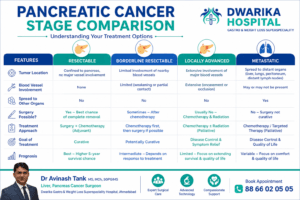
Patients are generally divided into three categories.
| Stage | Surgery Possible? | Chance of Cure |
| Resectable | Yes | Highest |
| Borderline Resectable | Often after chemotherapy | Possible |
| Locally Advanced | Usually not initially | Rare |
| Metastatic | No | Surgery not curative |
What Makes a Tumour Resectable?
Doctors evaluate several factors.
1. Tumour Has Not Spread
Cancer should remain confined to the pancreas or nearby tissues.
Spread to:
- Liver
- Lungs
- Peritoneum
- Distant lymph nodes
usually prevents curative surgery.
2. Blood Vessel Involvement
The pancreas lies beside several major blood vessels.
These include:
- Superior mesenteric artery
- Superior mesenteric vein
- Portal vein
- Celiac artery
Minor venous involvement may still allow surgery with vascular reconstruction, whereas extensive arterial involvement often requires chemotherapy first or may preclude surgery.
3. Patient Fitness
Major pancreatic surgery requires:
- Good heart function
- Adequate lung function
- Acceptable nutritional status
- Ability to recover from major surgery
Age alone does not determine eligibility.
Types of Pancreatic Cancer Surgery
The operation depends on where the tumour is located.
Tumours in the Head of the Pancreas
Usually require:
Whipple Procedure (Pancreaticoduodenectomy)
This removes:
- Head of pancreas
- Duodenum
- Gallbladder
- Part of bile duct
- Sometimes part of the stomach
Tumours in the Body or Tail
Usually require:
Distal Pancreatectomy
This removes:
- Body and tail of pancreas
- Usually the spleen
Extensive Disease Within the Pancreas
Selected patients may require:
Total Pancreatectomy
This removes:
- Entire pancreas
- Sometimes nearby organs depending on tumour extent
Patients require lifelong insulin and pancreatic enzyme replacement afterward.
Why Chemotherapy Is Usually Recommended
Even after successful surgery, microscopic cancer cells may remain elsewhere in the body.
Chemotherapy helps:
- Destroy hidden cancer cells.
- Reduce recurrence.
- Improve long-term survival.
Some patients receive chemotherapy:
- Before surgery (neoadjuvant therapy)
- After surgery (adjuvant therapy)
- Both before and after surgery in selected cases
Can Borderline Tumours Become Operable?
Yes.
Modern chemotherapy sometimes shrinks tumours or limits their involvement with blood vessels.
After reassessment:
- Previously inoperable tumours may become removable.
- Complete resection becomes possible in selected patients.
This is called conversion surgery.
Factors That Influence Success
Several factors affect outcomes.
Tumour Factors
- Small tumour size
- Early stage
- Negative lymph nodes
- Clear surgical margins
Patient Factors
- Good nutrition
- No severe medical illnesses
- Good physical fitness
- Smoking cessation
Treatment Factors
- High-volume pancreatic surgery centre
- Experienced multidisciplinary team
- Appropriate chemotherapy
- Regular follow-up
What Happens After Surgery?
Recovery usually includes:
- Hospital stay of 7–14 days (varies)
- Gradual return to eating
- Walking soon after surgery
- Pain control
- Nutritional support
- Pancreatic enzyme supplements if required
Most patients begin chemotherapy several weeks after recovery if appropriate.
Does Surgery Guarantee a Cure?
No.
Although surgery offers the best chance of cure, recurrence can still occur because microscopic cancer cells may have spread before diagnosis.
However, patients who undergo successful surgery followed by chemotherapy have significantly better long-term outcomes than those who cannot undergo surgery.
Common Misunderstandings
| Misconception | Reality |
| Surgery always cures pancreatic cancer | Surgery offers the best chance but not a guarantee. |
| Everyone with pancreatic cancer can have surgery | Many patients present too late for immediate surgery. |
| Older patients cannot undergo surgery | Healthy older adults may benefit from surgery. |
| Chemotherapy means surgery failed | Chemotherapy is part of standard curative treatment. |
| Large tumours are always inoperable | Some can become operable after neoadjuvant therapy. |
What Current Evidence Shows
Current international guidelines from NCCN, ESMO, and ASCO agree that surgery remains the cornerstone of curative treatment for resectable pancreatic cancer. Patients should undergo detailed staging with high-quality CT imaging and be evaluated by a multidisciplinary team that includes pancreatic surgeons, medical oncologists, radiologists, gastroenterologists, and pathologists.
Evidence also supports the use of chemotherapy before or after surgery in many patients to improve survival and reduce the risk of recurrence. Increasingly, patients with borderline resectable disease benefit from neoadjuvant therapy followed by surgery when appropriate. Treatment at experienced high-volume centres is associated with better surgical outcomes and lower complication rates.
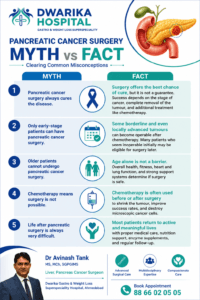
Common Myths and Facts
Myth 1
Pancreatic cancer is always incurable.
Fact: Early-stage pancreatic cancer can sometimes be cured with surgery combined with chemotherapy.
Myth 2
If surgery is not possible initially, it will never be possible.
Fact: Some tumours become operable after effective chemotherapy.
Myth 3
Chemotherapy is only used when surgery cannot be performed.
Fact: Chemotherapy is commonly used before and after surgery to improve cure rates.
Myth 4
Older patients should avoid pancreatic surgery.
Fact: Overall health and fitness are more important than chronological age.
Myth 5
Removing the pancreas always results in poor quality of life.
Fact: Many patients return to active lives with appropriate enzyme replacement, diabetes management when needed, nutritional support, and regular follow-up.
Dr. Avinash Tank’s Perspective
Pancreatic cancer should never be considered untreatable simply because of its diagnosis. The most important step is an accurate assessment of whether the tumour can be safely removed. Advances in imaging, surgical techniques, anaesthesia, and chemotherapy have expanded treatment options for many patients who would previously have been considered inoperable.
Every patient deserves evaluation by a multidisciplinary team experienced in pancreatic diseases. Decisions should not be based on a single scan or opinion. Early referral, appropriate staging, and individualized treatment planning can significantly influence outcomes. Even when surgery is not immediately feasible, modern chemotherapy may create an opportunity for curative treatment in selected patients.
Key Takeaways
- ✅ Surgery offers the best chance of curing pancreatic cancer.
- ✅ Only early-stage or selected borderline tumours are suitable for surgery.
- ✅ Complete tumour removal is the goal of surgery.
- ✅ Chemotherapy is an essential part of curative treatment.
- ✅ Early diagnosis increases the likelihood of successful surgery.
- ✅ High-volume pancreatic surgery centres achieve better outcomes.
- ✅ Some patients become eligible for surgery after chemotherapy.
- ✅ A multidisciplinary team should evaluate every patient with pancreatic cancer.
Related Resources
Disease Hub
- Pancreatic Cancer
Service Page
- Pancreatic Cancer Surgery
Related Articles
- What Are the First Signs of Pancreatic Cancer?
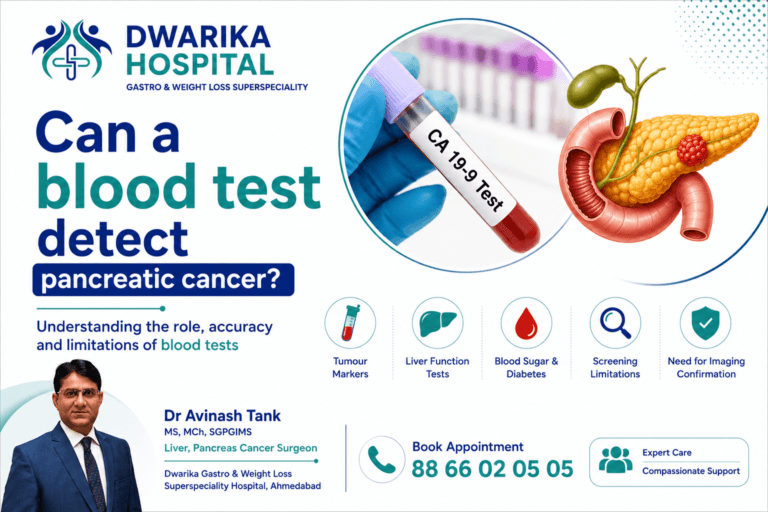
- Can Pancreatic Cancer Be Detected in Blood Tests?
- Is Pancreatic Cancer Hereditary?
- What Is the Survival Rate for Pancreatic Cancer?
- What Is the Whipple Procedure?
Frequently Asked Questions
Can pancreatic cancer be completely cured?
Some patients with early-stage pancreatic cancer who undergo complete surgical removal followed by chemotherapy achieve long-term disease-free survival. However, not every patient is eligible for surgery, and ongoing follow-up is essential because recurrence can occur.
How do doctors decide whether surgery is possible?
Doctors use contrast-enhanced CT scans, MRI, endoscopic ultrasound (EUS), and sometimes PET-CT to determine tumour size, blood vessel involvement, and whether the cancer has spread. Overall fitness and medical conditions are also considered.
What is the Whipple procedure?
The Whipple procedure (pancreaticoduodenectomy) is a major operation used for cancers in the head of the pancreas. It removes the tumour along with nearby structures and then reconstructs the digestive tract.
Can chemotherapy shrink pancreatic cancer enough for surgery?
Yes. In patients with borderline resectable or some locally advanced tumours, chemotherapy—and occasionally chemoradiation—can shrink or stabilize the cancer, allowing surgery in selected cases.
How long does recovery take after pancreatic surgery?
Hospital recovery typically lasts one to two weeks, while full recovery may take several months. Nutrition, physical activity, enzyme replacement, and follow-up care all play important roles.
Is pancreatic surgery safe?
Pancreatic surgery is complex but is generally safe when performed by experienced surgeons at high-volume centres. Careful patient selection and specialized perioperative care reduce the risk of complications.
Can pancreatic cancer return after surgery?
Yes. Despite successful surgery, microscopic cancer cells may remain. Adjuvant chemotherapy and regular surveillance help reduce the risk of recurrence and detect any return of disease early.
Does every pancreatic tumour require surgery?
No. Some pancreatic tumours are benign or low-grade and may require different management. Others may not be removable because of advanced spread. Treatment is individualized based on tumour type and stage.
References
- National Comprehensive Cancer Network (NCCN). Clinical Practice Guidelines in Oncology: Pancreatic Adenocarcinoma (latest version).
- European Society for Medical Oncology (ESMO). Pancreatic Cancer Clinical Practice Guidelines.
- American Society of Clinical Oncology (ASCO). Guideline on Potentially Curable Pancreatic Adenocarcinoma.
- World Health Organization (WHO). Cancer Fact Sheets: Pancreatic Cancer.
- Neoptolemos JP, et al. Adjuvant Chemotherapy for Resected Pancreatic Cancer. New England Journal of Medicine.
- Conroy T, et al. FOLFIRINOX versus Gemcitabine in Pancreatic Cancer. New England Journal of Medicine.
- Relevant peer-reviewed reviews and clinical studies indexed in PubMed on pancreatic cancer surgery, neoadjuvant therapy, and long-term outcomes.
Internal Linking Suggestions
Use at least five contextual internal links within the article:
- Disease Hub: Pancreatic Cancer
- Service Page: Pancreatic Cancer Surgery
- Related Article: What Are the First Signs of Pancreatic Cancer?
- Related Article: Can Pancreatic Cancer Be Detected in Blood Tests?
- Related Article: What Is the Survival Rate for Pancreatic Cancer?
Image Suggestions
- Hero Image: Illustration showing the pancreas with a localized tumour and the caption “Surgery offers the best chance of cure for selected patients with early-stage pancreatic cancer.”
- Infographic: Who Can Have Pancreatic Cancer Surgery? – flowchart from diagnosis → staging → resectable/borderline/metastatic → treatment pathway.
- Anatomy Diagram: Normal pancreas highlighting the head, body, and tail, with common tumour locations.
- Comparison Table Graphic: Resectable vs Borderline Resectable vs Locally Advanced vs Metastatic pancreatic cancer.
- Myth vs Fact Infographic: Five common misconceptions about pancreatic cancer surgery.
- Recovery Timeline Graphic: Preoperative assessment → surgery → hospital stay → recovery → chemotherapy → follow-up.
FAQ Schema Suggestions
Implement structured data using FAQPage Schema with the eight FAQs above. Combine this article with MedicalWebPage, MedicalCondition, and Physician schema to improve visibility in Google Search and AI-powered search systems.

Super-specialist GI, bariatric & cancer surgeon. SGPGIMS (India's premier GI centre) + advanced training in Japan & South Korea. Read full profile →
Last reviewed: July 2026



Comments
Be the first to share your thoughts on this article.