

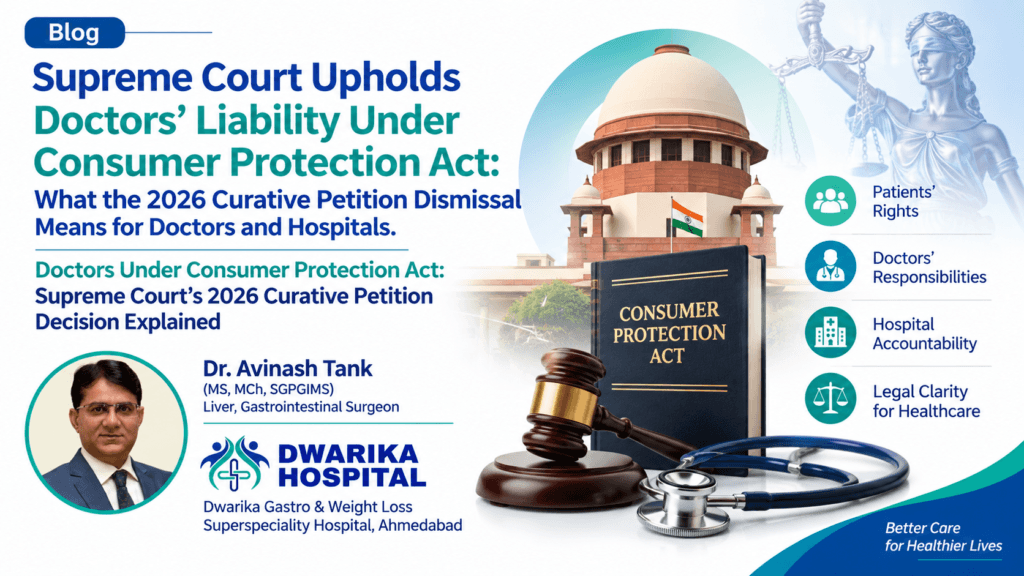
Supreme Court Upholds Doctors’ Liability Under Consumer Protection Act: What the 2026 Curative Petition Dismissal Means for Doctors and Hospitals. Doctors Under Consumer Protection Act: Supreme Court’s 2026 Curative Petition Decision Explained
Medical-Legal Update | Doctors | Hospitals | Medical Negligence | Consumer Protection Act | Indian Medical Association v. V.P. Shantha
Key Takeaway
The Supreme Court of India has dismissed a curative petition challenging the legal position that paid medical services fall within the Consumer Protection Act (CPA). The decision leaves intact the landmark 1995 judgment in Indian Medical Association v. V.P. Shantha, under which patients can seek consumer-law remedies against doctors and hospitals for alleged deficiency in medical services.
The latest development is significant for doctors, surgeons, hospitals, nursing homes and other healthcare providers because it confirms that the consumer-law route for medical-service disputes continues to remain available.
According to the report published on September 14, 2026, a five-judge Supreme Court bench comprising Justices Vikram Nath, B.V. Nagarathna, M.M. Sundresh, Prashant Kumar Mishra and K.V. Viswanathan dismissed the curative petition filed by the Medico Legal Society of India. The Court found that no case was made out under the strict parameters governing curative petitions. (Medical Dialogues)
What has the Supreme Court decided in 2026?
The latest order does not create a new category of liability for doctors. Instead, it closes another attempt to reopen the legal position established by the Supreme Court in 1995.
The Court’s September 9, 2026 order dismissed the curative petition after applying the principles governing curative jurisdiction laid down in Rupa Ashok Hurra v. Ashok Hurra.
In practical terms, the dismissal means that the Supreme Court has not disturbed the existing legal framework under which medical services provided for consideration can fall within consumer-protection law.
In simple terms
Doctors and hospitals providing paid medical services remain subject to consumer-law proceedings concerning alleged deficiency in service.
The dismissal does not mean that every unsuccessful medical treatment amounts to negligence or deficiency in service.
That distinction remains critically important.
Why is the 1995 V.P. Shantha judgment important?
The legal foundation goes back to the Supreme Court’s landmark judgment in:
Indian Medical Association v. V.P. Shantha & Others, decided on November 13, 1995.
The case considered whether doctors, hospitals and nursing homes provide a “service” within the meaning of the Consumer Protection Act, 1986.
The Supreme Court held that medical services provided for consideration could fall within the statutory definition of “service”. (Indian Kanoon)
The judgment covered medical services including:
- Consultation
- Diagnosis
- Medical treatment
- Surgical treatment
- Hospital services
- Nursing-home services
The Court also held that the fact that doctors are regulated by professional medical councils does not, by itself, remove their services from consumer-protection legislation. (Indian Kanoon)
What medical services are covered?
The V.P. Shantha framework broadly covers medical services where the patient receives healthcare services for consideration.
This can include services provided by:
- Individual doctors
- Surgeons
- Private hospitals
- Nursing homes
- Clinics
- Diagnostic and treatment facilities
- Hospitals where doctors work as part of the institution
The 1995 judgment also addressed situations involving partly free and partly paid medical services. Completely free medical services provided to everyone fall into a different category under the consumer-law framework, whereas a hospital or establishment that provides services to some patients on a paying basis may still come within the definition of service. (Indian Kanoon)
Does this mean every bad outcome is medical negligence?
No.
This is perhaps the most important point for doctors.
Being covered by the Consumer Protection Act does not mean that a doctor becomes legally liable simply because:
- A surgery has a complication
- A treatment does not produce the expected result
- A patient deteriorates despite appropriate treatment
- A known surgical complication occurs
- A patient has an adverse drug reaction
- A high-risk procedure has an unfavourable outcome
Medical negligence requires consideration of the standard of care, circumstances of treatment, professional judgment, causation and the facts of the individual case.
The Supreme Court’s earlier jurisprudence has recognised that doctors owe patients duties relating to deciding whether to undertake a case, deciding what treatment to provide and administering that treatment with appropriate care. (Consumer Affairs)
Therefore:
An adverse outcome is not automatically proof of negligence.
This distinction is essential when discussing consumer complaints against doctors.
Why was the 1995 judgment challenged again?
The issue resurfaced after the Supreme Court considered whether lawyers could be proceeded against under the Consumer Protection Act for alleged deficiency in professional services.
In May 2024, a two-judge Supreme Court bench observed that the 1995 V.P. Shantha judgment concerning medical professionals deserved reconsideration. The Court referred the question for consideration in the context of its reasoning concerning professional services. (Medical Dialogues)
This generated considerable interest among the medical community because reconsideration of V.P. Shantha could potentially have altered the consumer-law position applicable to doctors.
However, the Supreme Court subsequently declined to reconsider the medical-profession issue in that proceeding. In November 2024, a three-judge bench held that the reference concerning doctors was not necessary in that case and disposed of the reference. (Medical Dialogues)
A subsequent review petition was also dismissed.
The latest development is the dismissal of the curative petition, effectively bringing the latest challenge to the 1995 position to an end.
What does the 2026 decision mean for doctors?
1. Consumer complaints against doctors remain possible
Doctors cannot assume that professional regulation by the National Medical Commission or State medical authorities excludes them from consumer-law proceedings.
The V.P. Shantha principle remains operative. (Indian Kanoon)
2. Hospitals may also face consumer proceedings
The legal framework can extend beyond the individual treating doctor to hospitals and healthcare establishments depending on the facts and the relationship between the patient, doctor and institution.
The 1995 judgment recognised the applicability of consumer law to relevant hospital and nursing-home services. (Indian Kanoon)
3. Documentation becomes extremely important
For doctors and hospitals, comprehensive clinical documentation remains one of the most important safeguards in medico-legal disputes.
Important records include:
- Initial clinical assessment
- Diagnosis and differential diagnosis
- Investigation reports
- Treatment plan
- Informed consent
- Procedure notes
- Anaesthesia records
- Medication records
- Postoperative monitoring
- Nursing records
- Referral and consultation notes
- Documentation of complications
- Communication with the patient and family
- Discharge summary
- Follow-up advice
4. Informed consent remains important
A consent form should not be treated merely as a signature on a standard document.
Where relevant, documentation should demonstrate that the patient was informed about:
- Nature of the proposed procedure
- Expected benefits
- Material risks
- Significant complications
- Available alternatives
- Consequences of refusing treatment
Consumer-forum proceedings can examine the clinical record when determining whether the treatment and communication were appropriate.
What should surgeons learn from this judgment?
For surgeons, the practical lesson is not to avoid difficult or high-risk cases.
Rather, it is to ensure that clinical decision-making is properly documented.
For example, when a recognised complication occurs, the record should clearly establish:
Preoperative assessment → informed consent → operative decision-making → intraoperative findings → management of complication → postoperative monitoring → specialist consultation/referral → patient communication → follow-up.
This creates a contemporaneous clinical record showing how the medical team responded to the patient’s condition.
A complication that is promptly recognised and appropriately managed should not automatically be equated with negligent treatment.
Consumer Protection Act vs Medical Council/NMC proceedings
A doctor may potentially face different forms of legal or professional scrutiny.
| Proceeding | Broad purpose |
| Consumer proceeding | Addresses alleged deficiency in service and consumer remedies |
| Professional disciplinary proceeding | Examines professional conduct/ethical violations |
| Civil proceeding | May involve claims for damages depending on the legal circumstances |
| Criminal proceeding | Applies where the facts meet the applicable criminal-law threshold |
These mechanisms are not interchangeable.
A consumer complaint is therefore not the same thing as a professional-misconduct complaint before a medical regulator.
Why the Supreme Court’s 2026 order matters
The importance of the latest order is primarily legal continuity.
The Supreme Court has not granted the latest challenge to the consumer-law status of medical services.
Therefore, as of September 2026:
Paid medical services remain within the consumer-protection framework established by Indian Medical Association v. V.P. Shantha.
The latest curative-petition dismissal does not establish that doctors are liable for every adverse outcome. Rather, it leaves intact the legal avenue through which patients may pursue allegations of deficiency in medical services. (Medical Dialogues)
What doctors and hospitals should do now
Healthcare professionals should consider strengthening their medico-legal documentation systems rather than changing clinical practice merely because of this ruling.
Practical checklist
Before treatment
- Establish and document the diagnosis or working diagnosis.
- Record relevant risk factors and comorbidities.
- Document treatment alternatives where clinically relevant.
- Obtain appropriate informed consent.
- Clearly document high-risk procedures and foreseeable material complications.
During treatment
- Maintain accurate procedure and operative notes.
- Record significant intraoperative findings.
- Document unexpected events and the steps taken to manage them.
- Record consultations and referrals.
After treatment
- Monitor appropriately.
- Document postoperative complications.
- Record escalation of care where required.
- Communicate significant developments to the patient/family.
- Provide clear discharge and follow-up instructions.
Bottom Line for Doctors
The Supreme Court has not exempted doctors from the Consumer Protection Act.
The dismissal of the 2026 curative petition leaves the landmark Indian Medical Association v. V.P. Shantha framework intact.
For doctors, the key message is:
Consumer-law accountability continues, but consumer-law coverage does not mean automatic liability for every adverse medical outcome.
The strongest protection remains appropriate clinical care, evidence-based decision-making, informed consent, timely management of complications and accurate contemporaneous documentation.
For patients, the ruling confirms that the consumer-protection route remains available where there is an allegation of deficiency in medical service.
Frequently Asked Questions
Are doctors covered under the Consumer Protection Act in India?
Yes. Under the Supreme Court’s Indian Medical Association v. V.P. Shantha ruling, medical services provided for consideration fall within the consumer-protection framework, subject to the principles and exclusions recognised by the Court. (Indian Kanoon)
Has the Supreme Court removed doctors from the Consumer Protection Act in 2026?
No. The Supreme Court dismissed the curative petition challenging the existing legal position. The 1995 V.P. Shantha framework therefore remains in place. (Medical Dialogues)
Does every surgical complication amount to medical negligence?
No. A complication or poor outcome does not automatically establish negligence. The circumstances, standard of care, clinical decision-making, causation and response to the complication must be examined.
Can a patient file a consumer complaint against a hospital?
Yes, where the relevant medical service falls within the consumer-law framework and the statutory requirements are satisfied. The 1995 Supreme Court judgment specifically considered medical services provided by hospitals and nursing homes. (Indian Kanoon)
Does informed consent protect a doctor from all medico-legal claims?
No. Consent is an important component of patient communication and medico-legal documentation, but a consent form does not provide blanket immunity from liability for negligent treatment.
What is the significance of the 1995 Indian Medical Association v. V.P. Shantha judgment?
It is the landmark Supreme Court decision that brought qualifying paid medical services within the definition of “service” under the Consumer Protection Act, thereby enabling patients to pursue consumer-law remedies for alleged deficiency in medical services. (Indian Kanoon)
Editorial Note
This article is an educational medical-legal analysis, not legal advice. The precise applicability of consumer law depends on the facts of an individual case, the nature of the healthcare service, payment arrangements and applicable legislation and judicial precedents.
Primary legal reference: Indian Medical Association v. V.P. Shantha & Others, Supreme Court of India, 13 November 1995. (Indian Kanoon)
Latest development: Supreme Court dismissal of the curative petition challenging the existing position on doctors’ liability under consumer law, reported September 14, 2026. (Medical Dialogues)
Was this article helpful?

Super-specialist GI, bariatric & cancer surgeon. SGPGIMS (India's premier GI centre) + advanced training in Japan & South Korea. Read full profile →
Last reviewed: July 2026



Comments
Be the first to share your thoughts on this article.