

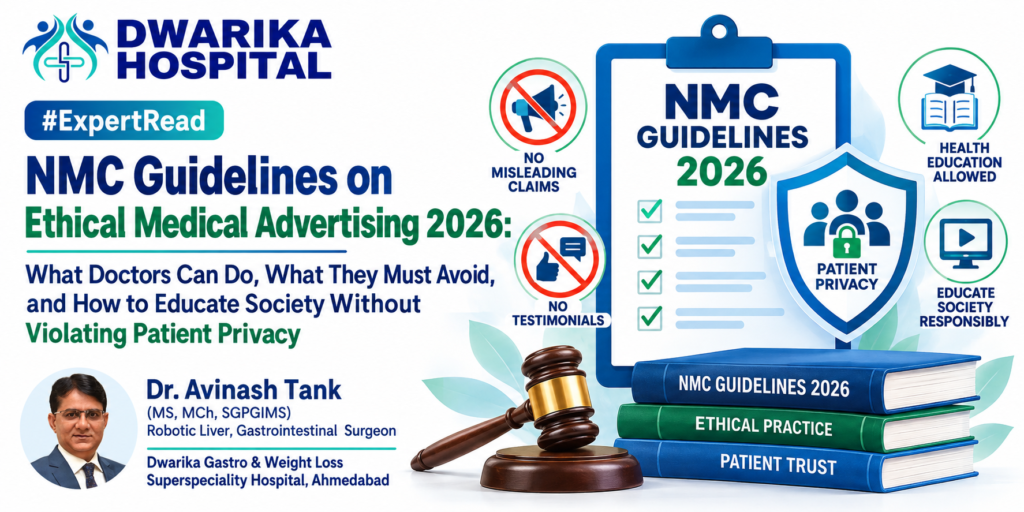
Author: Dr. Avinash Tank (MS, MCh, SGPGIMS)
Specialty: Robotic Liver & Gastrointestinal Surgery
Institution: Dwarika Gastro & Weight Loss Superspeciality Hospital, Ahmedabad
Introduction: A New Framework for Ethical Medical Communication in India
Doctors and hospitals increasingly use websites, YouTube, Instagram, Facebook, WhatsApp, podcasts and other digital platforms to educate people about diseases, treatment options and preventive healthcare.
These platforms can improve health literacy, encourage early diagnosis and help patients make informed decisions. However, misleading treatment claims, exaggerated success rates, paid promotional endorsements and the unauthorized use of patient photographs can undermine public trust.
The National Medical Commission (NMC), through its Guidelines on Ethical Advertising and Public Communication by Hospitals/Medical Institutions and Registered Medical Practitioners, dated 6 October 2026, establishes a framework for responsible medical communication.
The stated objectives include protecting the dignity of the medical profession, preventing the commercialization of healthcare, protecting patients from misleading claims, maintaining privacy and ensuring that medical information remains factual, ethical and evidence-based.
Official source: Read the original NMC guidelines (PDF)
This article explains what doctors can communicate publicly, which promotional practices should be avoided, and how medical professionals can continue educating society without compromising patient confidentiality.
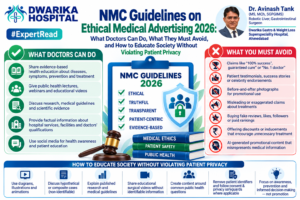
1. What do the new NMC guidelines cover?
The guidelines apply to registered medical practitioners (RMPs), hospitals and medical institutions, including their digital and social-media communications.
They address:
- Medical advertising and professional self-promotion.
- Hospital websites and descriptions of medical services.
- Social-media posts, videos, podcasts and online campaigns.
- Claims about treatment success, superiority and professional achievements.
- Patient testimonials, photographs, clinical images and medical records.
- Paid promotions, influencer marketing and online reviews.
- AI-generated content and the use of patient information in AI systems.
- Public health education, professional announcements and educational lectures.
The document also states that applicable laws and other binding regulations continue to apply. Its provisions should therefore be read alongside relevant medical ethics, privacy and data-protection requirements.
2. What can doctors do under the NMC guidelines?
The guidelines permit several forms of professional communication, provided they remain factual, educational, non-misleading and within the applicable rules.
A. Publish evidence-based health education articles
Doctors can educate the public about diseases, symptoms, investigations, treatment choices, complications and prevention.
Examples include:
- Warning signs of colorectal cancer and when to seek medical evaluation.
- Symptoms of gallstones and complications of acute cholecystitis.
- Obesity management, metabolic health and the role of bariatric surgery.
- Liver disease prevention and the importance of early diagnosis.
- The benefits, limitations and risks of laparoscopic and robotic surgery.
- Evidence-based information about screening and preventive healthcare.
Articles should explain the scientific evidence fairly, including uncertainties, contraindications and limitations where relevant.
Good practice: Write to improve public understanding, rather than to pressure readers into choosing a particular doctor or hospital.
B. Deliver public lectures and educational videos
The guidelines permit medical practitioners to give public-health lectures or talks about diseases in their own name and designation without promoting their employer or organization.
Doctors can use educational presentations, interviews, webinars and appropriate electronic media to discuss diseases and public-health concerns.
For example, a surgeon could publish a video explaining:
- When gallbladder surgery is generally recommended.
- Why some gallbladder operations are technically difficult.
- What patients should know before colorectal cancer surgery.
- How to recognize symptoms that require urgent medical attention.
The content should remain educational rather than becoming a solicitation for patients.
C. Publish research and discuss medical evidence
The guidelines expressly allow research-based communication involving interesting case studies published in reputed medical journals.
Doctors can discuss peer-reviewed research, clinical guidelines and new developments in medicine. They should accurately describe the study design, population, limitations and strength of evidence.
A single successful case should not be presented as proof that a treatment is universally effective.
D. Maintain a factual hospital website
Hospitals and medical institutions may communicate factual, objective and verifiable information about their services and facilities.
Depending on the applicable rules, this can include:
- Hospital name and contact information.
- Departments and specialties.
- Names and qualifications of medical practitioners.
- Diagnostic facilities and equipment.
- Emergency services.
- Accreditation status.
- Available services and relevant fees or charges.
The information must not be turned into misleading comparative advertising, inducements or unsupported claims of superiority.
E. Make permitted professional announcements
The guidelines permit specified factual, non-promotional announcements, including announcements relating to starting practice, changes in practice type or address, temporary absence, resumption of practice and succession to another practice.
The document also allows certain professional announcements, such as public declarations of charge, subject to its conditions.
These permissions should not be interpreted as unrestricted permission to advertise every professional achievement or hospital event.
F. Use social media responsibly
Social media can be used for health education and appropriate professional communication.
A useful approach is to create content around public-health questions rather than promotional slogans.
For example:
Appropriate educational topic: “Five warning signs of colorectal cancer that should not be ignored.”
Less appropriate promotional approach: “Visit the best cancer surgeon in the city for guaranteed results.”
The first informs the public. The second combines superiority and outcome claims that may be misleading or prohibited.
Source: NMC guidelines, Sections 5, 6, 8 and 9.
3. What should doctors and hospitals NOT do?
The NMC document identifies prohibited or restricted promotional practices. The following table translates these provisions into practical examples.
| Practice to avoid | Why it is problematic |
|---|---|
| Claiming “100% success,” “guaranteed cure” or “100% treatment” | Creates unsupported expectations about clinical outcomes. |
| Calling oneself “No. 1,” “best doctor” or “top specialist” | Uses superiority claims that are prohibited unless the specific permitted conditions are met; the guideline also restricts unverifiable comparative claims. |
| Soliciting patients through promotional campaigns | Can turn medical communication into commercial solicitation. |
| Publishing testimonials or success stories for professional promotion | Patient consent alone does not make prohibited promotional content permissible. |
| Using before-and-after photographs to advertise results | The guidelines restrict the promotional use of such images. |
| Publicizing celebrity patients or their surgical outcomes | Risks exploiting patient identity and medical experience for publicity. |
| Buying fake reviews, likes, followers or ratings | Manipulates public perception of professional standing. |
| Paying for rankings or misleading search visibility | Can create a false impression of professional superiority. |
| Offering discounts or inducements that encourage unnecessary treatment | May encourage unnecessary consultations, investigations or procedures. |
| Using paid influencers to promote medical services improperly | Risks disguising commercial promotion as independent health advice. |
| Promoting unproven treatments or making unsupported therapeutic claims | Misleads patients about the benefits and safety of treatment. |
These restrictions are described primarily in Sections 7 and 8 of the NMC document.
Important clarification: Can a doctor ever describe professional qualifications or experience?
Doctors should accurately state their recognized qualifications, registration status, designation and relevant professional information in contexts permitted by the guidelines.
Continue Reading — Free
Get the complete expert guide from Dr. Avinash Tank.
Free, always. No payment, no spam.
Continue Reading — Free
Get the complete expert guide from Dr. Avinash Tank.
Free, always. No payment, no spam — just the complete guide sent straight to your screen.
However, factual credentials are different from promotional claims such as “the best surgeon,” “No. 1 in India” or “the highest success rate.”
The guidelines specifically restrict claims of personal achievement, professional success, superiority and unverified outcomes. A doctor should not assume that a claim becomes acceptable simply because it is popular in medical advertising.
4. Patient privacy: What does the NMC document say?
Patient confidentiality is one of the most important aspects of the new framework.
Section 6 states that patient information, photographs, videos, medical records and clinical images must not be used for advertising purposes except where the use is permitted by law and the necessary consent and safeguards have been complied with.
The guidelines also clarify that consent does not automatically make a testimonial, endorsement, promotional patient story or before-and-after depiction permissible.
Where disclosure is legally permitted or required, consent must be specific, informed, documented and compliant with applicable privacy and data-protection requirements.
Even when disclosure is lawful, reasonable safeguards should be used to prevent unnecessary identification of the patient.
What information could identify a patient?
Privacy risks extend beyond a patient’s name or face.
Potential identifiers include:
- Facial photographs and recognizable voices.
- Hospital numbers, prescription labels and medical records.
- Names, addresses, phone numbers and dates of birth.
- Exact admission or surgery dates combined with other details.
- Distinctive tattoos, scars or other recognizable features.
- Images of monitors, computer screens or documents containing personal information.
- A rare diagnosis combined with a location, occupation or other identifying details.
Removing the patient’s name is not always enough. Several apparently harmless details can combine to identify an individual.
5. How can doctors educate society without compromising patient privacy?
A practical approach is to separate education about a disease from publicity about an identifiable patient’s treatment.
Method 1: Use diagrams, illustrations and animations
For most public-health topics, a carefully designed illustration can communicate the essential medical information without revealing any patient’s identity.
Examples include:
- An illustration explaining how gallstones obstruct the cystic duct.
- A diagram showing the progression of colorectal cancer.
- An animation explaining laparoscopic surgery.
- A graphic explaining the stages of fatty liver disease.
- An illustration of the digestive tract and the location of a gastrointestinal tumour.
These methods are particularly useful for YouTube videos, hospital blogs, patient-awareness campaigns and waiting-room displays.
Method 2: Teach through fictional or composite cases
Doctors can create hypothetical clinical scenarios that illustrate a common diagnostic or treatment problem.
For example:
“A 55-year-old patient develops persistent abdominal discomfort, unexplained weight loss and iron-deficiency anaemia. Which investigations should be considered?”
Such a case can teach the public about warning symptoms and appropriate evaluation without describing a real patient’s identifiable medical history.
If composite cases are used, they should be clearly labelled as illustrative rather than presented as an actual patient’s story.
Method 3: Discuss published research instead of publicizing individual patients
A doctor can explain what a peer-reviewed study shows, how many patients were included, what outcomes were measured and what limitations remain.
For example, a blog on laparoscopic cholecystectomy can discuss evidence concerning surgical timing, complications and accepted bailout procedures.
This teaches patients about the science of treatment without relying on an individual patient’s photograph or testimonial.
Method 4: Record educational surgical videos without identifiable information
Surgical videos can have considerable educational value for medical professionals and, where appropriate, the public.
Before publishing a video, the team should check for:
- Patient names or hospital identification numbers.
- Facial images or identifiable voices.
- Electronic medical records visible on screens.
- Consent forms, labels and other personal documents.
- Audio conversations revealing personal medical details.
- Metadata or overlays that could reveal identity.
The footage should be reviewed and edited to remove unnecessary identifiers.
Crucial distinction: De-identification and consent are necessary safeguards where applicable, but they do not automatically make a video acceptable for promotional use. The purpose and presentation of the video must also comply with the NMC guidelines.
Method 5: Use genuine public-health questions as the starting point
Instead of using a patient’s outcome to attract attention, create content that answers questions patients commonly ask.
Examples:
- When should a person with gallstones seek medical advice?
- What are the warning signs of colorectal cancer?
- What should patients know before bariatric surgery?
- What are the risks of robotic surgery?
- When is an endoscopy indicated?
- What symptoms after abdominal surgery require urgent assessment?
The focus remains on helping the public recognize problems and understand medical choices.
Method 6: Establish a written privacy-review process
Before any clinical photograph, video or case description is published, the responsible team should ask:
- Is this material necessary for genuine education?
- Can the same point be taught using an illustration or hypothetical case?
- Does the material contain direct or indirect identifiers?
- Is there a lawful basis for using the material?
- Where required, has specific, informed and documented consent been obtained?
- Does the content comply with the NMC restrictions on advertising and testimonials?
- Have the final video, image and caption all been checked?
- Could the content expose sensitive information even after editing?
If any of these questions remains unresolved, publication should be delayed until the issue is addressed.
6. Are patient testimonials and before-and-after photographs allowed if the patient gives consent?
This is a particularly important question for hospitals, surgeons and cosmetic or weight-loss services.
Consent is not a blanket exemption from the NMC’s advertising restrictions.
Section 6.2 states that consent does not, by itself, make permissible a testimonial, endorsement, promotional patient story, before-and-after depiction, success claim or other advertising practice prohibited under the guidelines.
Section 8.1 also restricts the publication of patient cases for promotional purposes, including surgical results and before-and-after photographs, outside the specified educational or scientific exceptions.
Therefore, a hospital should not assume that obtaining a signed consent form permits it to publish a patient’s photograph, video or recovery story as promotional material.
Where a clinical image is genuinely needed for scientific or educational purposes, the intended use, applicable legal requirements, patient privacy, consent and professional rules should all be assessed separately.
7. Can doctors use AI to create medical blogs, images and videos?
The guidelines specifically address AI-generated and AI-assisted promotional content.
Section 7.2 prohibits AI-generated or AI-assisted promotional campaigns for commercial gain when they violate the guidelines. It also restricts using AI-generated content to misrepresent diagnoses, treatment outcomes, professional qualifications, patient experiences or healthcare services.
The document further addresses the use of patient information as input to AI systems, requiring compliance with applicable privacy, data-protection and professional requirements.
Responsible use of AI in medical communication
AI can assist with drafting educational content, simplifying complex medical information, preparing diagrams and organizing research.
A responsible workflow should include:
- Verifying medical claims against authoritative evidence.
- Checking the original wording of relevant guidelines.
- Avoiding fabricated references or unsupported statistics.
- Removing patient identifiers before using clinical material in any AI workflow.
- Ensuring that any patient-data processing has a lawful basis and appropriate safeguards.
- Reviewing AI-generated images to ensure they do not falsely depict real clinical outcomes.
- Having a qualified medical professional review the final content.
AI should support medical education, not fabricate patient experiences or manufacture evidence of treatment success.
8. How should a hospital communicate its services ethically?
A hospital can develop a useful public-information strategy without relying on exaggerated claims.
For example, a hospital website may explain its departments, available diagnostic facilities, emergency services, recognized professional qualifications and the types of treatment offered, provided the information is factual and permitted.
A responsible website should also help patients understand:
- What symptoms warrant medical evaluation.
- Which investigations may be considered.
- The general treatment options for a condition.
- Potential risks and limitations.
- When emergency care is needed.
- Why an individual assessment is necessary before choosing treatment.
Avoid converting these educational pages into claims of superiority, guaranteed results or pressure to undergo procedures.
The guidelines also address the responsibilities of hospitals and medical institutions for ethical advertising and the use of photographs or images of medical practitioners in promotional material.
Hospitals should therefore review their websites, advertisements, social-media posts and external marketing arrangements against the full document rather than assuming that a third-party agency is responsible for compliance.
9. What are the consequences of violating the guidelines?
The NMC document establishes a graded enforcement framework in Section 10.
The measures described include warnings and mandatory ethics training, suspension of registration, removal from the register in specified circumstances and other applicable disciplinary or corrective measures.
The document describes different responses according to the seriousness and nature of the violation. These measures are not necessarily automatic in every case.
The applicable State Medical Council, and other competent authorities where relevant, determine action under the applicable legal framework and procedure.
Doctors and hospitals should therefore maintain appropriate records of their communication policies, consent processes, privacy reviews and corrective actions.
10. A practical checklist for doctors before publishing any health content
Use the following checklist for a blog, YouTube video, Instagram post, Facebook update, podcast or hospital website page.
-
Is the primary purpose to educate rather than solicit patients?
-
Are the medical claims accurate and supported by reliable evidence?
-
Have limitations, uncertainties and risks been represented fairly?
-
Does the content avoid guarantees, exaggerated success claims and unsupported superiority claims?
-
Does it avoid prohibited testimonials, endorsements and promotional patient stories?
-
Are patient photographs, videos and clinical images handled according to the NMC guidelines?
-
Have direct and indirect patient identifiers been removed where appropriate?
-
Have consent and other legal requirements been checked wherever applicable?
-
Has AI-generated content been checked for accuracy, authenticity and privacy risks?
-
Is the hospital’s information factual, objective and verifiable?
-
Has the final content been reviewed by an appropriately responsible person before publication?
A completed checklist does not guarantee legal compliance, but it creates a useful quality-control process.
11. Frequently asked questions
Can doctors publish health-awareness blogs under the new NMC guidelines?
Yes. The guidelines permit public-health education and specified forms of factual professional communication. The content must comply with restrictions on solicitation, misleading claims, privacy and professional advertising.
Can doctors make YouTube videos about diseases and surgical procedures?
Educational videos can be consistent with the guidelines when they explain medical information responsibly and avoid prohibited promotion. The use of patient footage requires particular care.
Can a doctor publish a patient’s successful surgery story?
A successful outcome does not automatically justify publication for promotional purposes. Patient testimonials and promotional patient stories are restricted, and consent alone does not override the relevant prohibitions.
Can a hospital publish photographs of its facilities and equipment?
The guidelines permit factual, objective and verifiable information about facilities, equipment, departments and services, subject to applicable restrictions. The content should not imply unsupported superiority or guaranteed outcomes.
Can doctors use AI to write medical articles?
AI-assisted drafting can support education, but the final content should be medically verified and must comply with the guidelines. Patient data should not be entered into AI systems without the required lawful basis and safeguards.
Can doctors discuss a real clinical case for education?
The guidelines allow specified research-based communication, including interesting case studies published in reputed medical journals. Any real clinical case must be handled consistently with applicable consent, confidentiality and privacy requirements, and must not be used as prohibited promotional content.
Does obtaining patient consent permit every form of medical publicity?
No. The guidelines expressly state that consent alone does not make prohibited promotional practices permissible.
When do the guidelines take effect?
The public notice dated 6 October 2026 states that the guidelines take effect immediately. The full document should be consulted for the precise conditions and applicable exceptions.
Conclusion: Ethical communication builds public trust
Medical communication is essential to modern healthcare. Patients need reliable information about disease prevention, early diagnosis, investigations, treatment choices and the risks and benefits of medical procedures.
The NMC guidelines establish an important distinction between educating society and promoting medical services through misleading or unethical claims.
Doctors can continue to publish evidence-based articles, conduct public-health lectures, explain research, create educational videos and provide factual information about their professional services within the applicable rules.
The most responsible approach is to put scientific accuracy, patient dignity, confidentiality and informed decision-making at the centre of every communication.
The guiding principle is simple: educate the public about the disease, the science and the treatment—not by exploiting a patient’s identity or using an individual outcome as a promotional guarantee.
Disclaimer: This article is an educational interpretation of the NMC guidelines dated 6 October 2026. It is not legal advice. Doctors and healthcare institutions should consult the complete official document and seek appropriate professional advice for specific compliance questions.
Primary reference: National Medical Commission — Guidelines on Ethical Advertising and Public Communication by Hospitals/Medical Institutions and Registered Medical Practitioners (PDF)
Related patient videos
 DWARIKA HOSPITALVerified Patient Story
Verified
DWARIKA HOSPITALVerified Patient Story
Verified  DWARIKA HOSPITALVerified Patient Story
Verified
DWARIKA HOSPITALVerified Patient Story
Verified  DWARIKA HOSPITALVerified Patient Story
Verified
DWARIKA HOSPITALVerified Patient Story
Verified 
Related treatments & services
A complete, personalised weight-loss programme — surgery where needed, plus nutrition, medical and lifestyle support for lasting results.
View service → 360 Diabetes ReversalA complete programme to reverse Type-2 diabetes — combining metabolic surgery where suitable with diet, medical and lifestyle care.
View service → Gallbladder Stone
Minimally invasive removal of the gallbladder (laparoscopic cholecystectomy) — the definitive, day-care treatment for painful gallstones.
View service →Was this guide helpful?

This article has not been individually medically reviewed. It is general education, not medical advice.